NSAIDs: Not Your Long Term Friend

💊 NSAIDs: Not Your Long Term Friend
The post-workout ritual is a sacred time for recovery, but many people reach for a bottle of ibuprofen or naproxen (NSAIDs) as soon as they feel the first signs of soreness. While these over-the-counter meds are effective at masking pain, recent science suggests they might actually be getting in the way of your gains.
This is where turmeric—and specifically its active compound, curcumin—is changing the conversation for athletes and weekend warriors alike.
🧬 The NSAID Dilemma: Are You Blunting Your Progress?
To understand why turmeric is gaining ground, we have to look at how the body repairs itself. Exercise creates microscopic tears in muscle fibers, often called exercise-induced muscle damage (EIMD). This "damage" triggers a necessary inflammatory response that signals the body to repair, strengthen, and grow those muscles (Davis et al., 2007).
NSAIDs (Non-Steroidal Anti-Inflammatory Drugs) work like a blunt instrument. They often inhibit both COX-1 and COX-2 enzymes. While this stops the pain, it can also lead to:
- Interfered Muscle Synthesis: Aggressively shutting down inflammatory signaling may impair muscle regeneration, satellite cell proliferation, and overall muscle hypertrophy (Liao et al., 2019; Vella et al., 2016).
- Affected Gut Health: Regular use of NSAIDs is associated with gastrointestinal distress and potential cardiovascular side effects (Davis et al., 2007).
- Impacted Long-Term Healing: Some evidence suggests that inhibiting prostaglandins can negatively affect the healing of bones, tendons, and muscle tissue (Liao et al., 2019; Su & O'Connor, 2013).

🌿 The Turmeric Advantage: Nature’s Precision Tool
Turmeric takes a more sophisticated approach. Rather than completely "turning off" your body's recovery signals, curcumin acts as a modulator (Gupta et al., 2012).
- Preferential Selectivity: Curcumin reduces the production of the COX-2 enzyme and modulates pro-inflammatory cytokines like TNF-α and IL-6 without the systemic knockdown typical of synthetic drugs (Davis et al., 2007; Fernández-Lázaro et al., 2020).
- Antioxidant Support: Beyond just inflammation, curcumin activates the Nrf2 pathway, which boosts your body's own antioxidant defenses (e.g., superoxide dismutase) to neutralize free radicals produced during exertion (Bai et al., 2023; Hewlings & Kalman, 2017).
- Faster Functional Recovery: Clinical trials show that curcumin supplementation consistently reduces perceived muscle soreness (DOMS) and markers of muscle damage like creatine kinase (CK), allowing for a quicker return to peak performance (Fernández-Lázaro et al., 2020).
🩺 Why Pain Punch is the Smarter Way to Recover
If you’ve ever tried to just add a spoonful of turmeric to a smoothie, you know two things: it’s messy, and curcumin is notoriously difficult for the body to absorb on its own due to low solubility and rapid metabolism (Gupta et al., 2012; Matthewman et al., 2023).
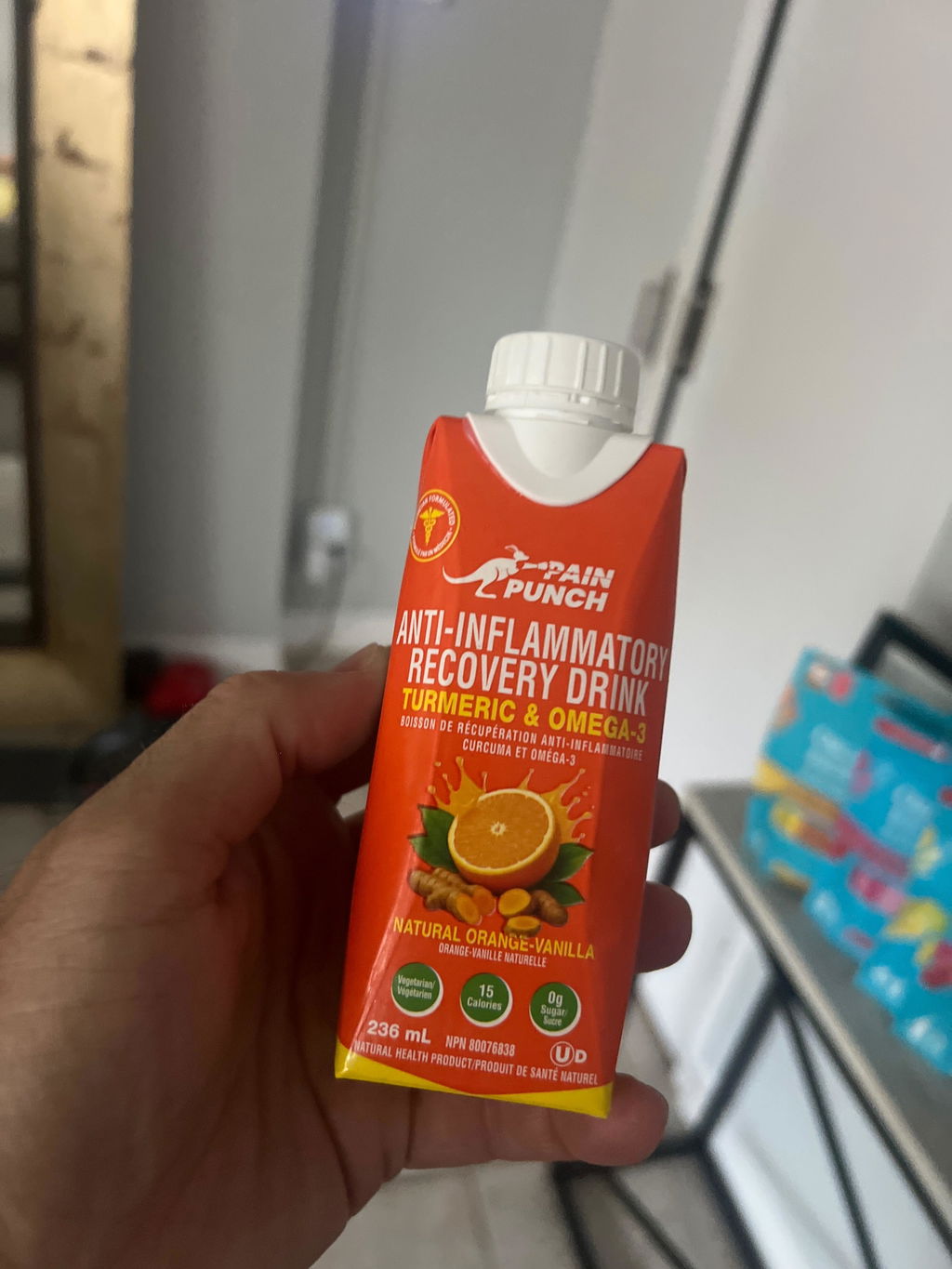
This is exactly why Pain Punch was developed. It’s not just about getting turmeric into your system; it’s about making sure it actually works.
- Optimized Formulations: Pain Punch utilizes formulations designed to overcome poor bioavailability, ensuring the active "free" curcuminoids actually reach your muscle tissues (Matthewman et al., 2023).
- Built for Performance: Unlike a pill that feels like "medicine," Pain Punch is a functional beverage designed for the active lifestyle, fitting perfectly into the post-exercise window when your body needs recovery nutrients most.
- Data-Driven Ingredients: With a focus on metabolic health, the ingredients are selected to support recovery without the side effects of traditional anti-inflammatories.

🏁 The Bottom Line
Pain is a signal, but it shouldn't be a permanent state. If you want to support your body’s natural ability to repair itself—without the side effects of over-the-counter drugs—it’s time to swap the medicine cabinet for the cooler.
Next time you finish a grueling session, reach for a Pain Punch. It’s the smarter, science-backed way to manage soreness and get back to your training faster.
References
- Bai, K.-Y., Liu, G.-H., Fan, C.-H., Kuo, L.-T., Hsu, W.-H., Yu, P.-A., & Chen, C.-L. (2023). 12-week curcumin supplementation may relieve postexercise muscle fatigue in adolescent athletes. Frontiers in Nutrition, 9. https://doi.org/10.3389/fnut.2022.1078108
- Davis, J. M., Murphy, E. A., Carmichael, M. D., Zielinski, M. R., Groschwitz, C. M., Brown, A. S., Gangemi, J. D., Ghaffar, A., & Mayer, E. P. (2007). Curcumin effects on inflammation and performance recovery following eccentric exercise-induced muscle damage. American Journal of Physiology-Regulatory, Integrative and Comparative Physiology, 292(6), R2168-R2173. https://doi.org/10.1152/ajpregu.00858.2006
- Fernández-Lázaro, D., Mielgo-Ayuso, J., Seco Calvo, J., Córdova Martínez, A., Caballero García, A., & Fernandez-Lazaro, C. (2020). Modulation of Exercise-Induced Muscle Damage, Inflammation, and Oxidative Markers by Curcumin Supplementation in a Physically Active Population: A Systematic Review. Nutrients, 12(2), 501. https://doi.org/10.3390/nu12020501
- Gupta, S. C., Patchva, S., & Aggarwal, B. B. (2012). Therapeutic Roles of Curcumin: Lessons Learned from Clinical Trials. The AAPS Journal, 15(1), 195-218. https://doi.org/10.1208/s12248-012-9432-8
- Hewlings, S. J., & Kalman, D. (2017). Curcumin: A Review of Its Effects on Human Health. Foods, 6(10), 92. https://doi.org/10.3390/foods6100092
- Liao, C.-H., Lin, L.-P., Yu, T.-Y., Hsu, Chih-Chin, Pang, J.-H. S., & Tsai, W.-C. (2019). Ibuprofen inhibited migration of skeletal muscle cells in association with downregulation of p130cas and CrkII expressions. Skeletal Muscle, 9(1). https://doi.org/10.1186/s13395-019-0208-z
- Matthewman, C., Krishnakumar, I. M., & Swick, A. G. (2023). Review: bioavailability and efficacy of ‘free’ curcuminoids from curcumagalactomannoside (CGM) curcumin formulation. Nutrition Research Reviews, 37(1), 14-31. https://doi.org/10.1017/s0954422423000033
- Su, B., & O'Connor, J. P. (2013). NSAID therapy effects on healing of bone, tendon, and the enthesis. Journal of Applied Physiology, 115(6), 892-899. https://doi.org/10.1152/japplphysiol.00053.2013
- Vella, L., Markworth, J. F., Paulsen, G., Raastad, T., Peake, J. M., Snow, R. J., Cameron-Smith, D., & Russell, A. P. (2016). Ibuprofen Ingestion Does Not Affect Markers of Post-exercise Muscle Inflammation. Frontiers in Physiology, 7. https://doi.org/10.3389/fphys.2016.00086